Summary
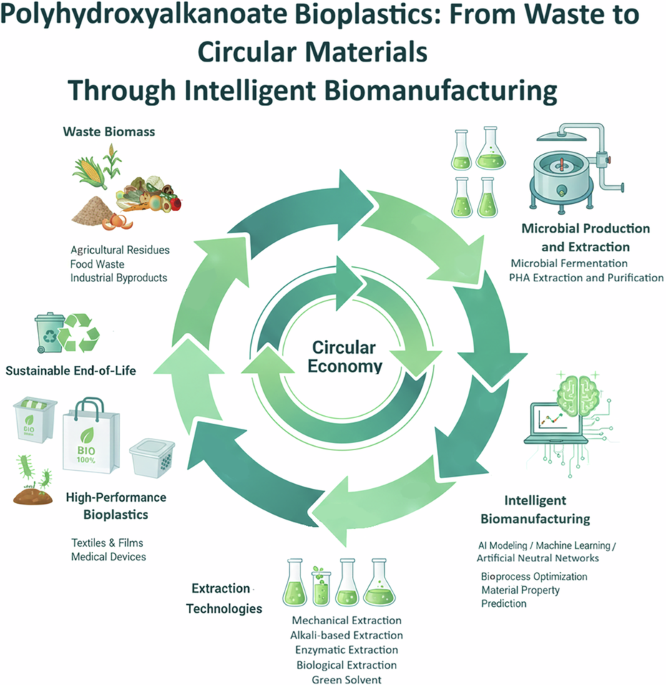
Biopolymers have emerged as sustainable alternatives to conventional plastics in food packaging, addressing issues of non-biodegradability and plastic pollution. Derived from renewable resources and agro-food waste, they offer both environmental and functional advantages14,15. PHA-based green compos…
Source: Nature

AI News Q&A (Free Content)
Q1: What are Polyhydroxyalkanoates (PHAs) and how are they produced?
A1: Polyhydroxyalkanoates (PHAs) are a type of biodegradable polymer produced naturally by microorganisms through the fermentation of sugars or lipids. These biopolymers serve as a source of energy and carbon storage for bacteria. PHAs can be customized with over 150 different monomers, which allows them to have diverse material properties ranging from thermoplastic to elastomeric. The adaptability of PHAs makes them suitable for various applications, including the manufacturing of bioplastics.
Q2: How does the use of organic waste contribute to the production of next-generation bioplastics?
A2: Organic waste can be converted into bioplastics such as PHAs, helping to reduce landfill waste and greenhouse gas emissions. Companies are developing technologies to use food waste as feedstock for PHA production, which is more complex than using traditional feedstocks like sugar and corn. This approach not only helps in waste management but also reduces reliance on fossil fuels.
Q3: What are some of the challenges faced in the commercialization of PHAs?
A3: While PHAs offer sustainable alternatives to conventional plastics, their commercialization faces challenges such as high production costs, low yield, and the need for specialized equipment. The industry is still in its early stages, with global players working on scaling up production and improving economic feasibility. Additionally, the extraction of PHAs can involve environmentally unfriendly solvents, though alternatives like acetic acid are being explored.
Q4: What role do machine learning methods play in the biodegradation prediction of PHA-based biopolymers?
A4: Machine learning methods, such as Random Forest and Extreme Gradient Boosting models, are used to predict the biodegradability of PHA-based biopolymers. These models analyze data to establish relationships between polymer structures and biodegradation metrics, aiding in the development of environmentally friendly bioplastics with predictable degradation behaviors. These approaches help optimize formulations for better environmental performance.
Q5: How is continuous biomanufacturing enhanced by the use of advanced anomaly detection methods?
A5: Continuous biomanufacturing processes benefit from advanced anomaly detection methods, such as ensemble generative adversarial networks (GANs), which identify deviations that could affect production. These methods are crucial in maintaining process stability, reducing disruptions, and improving economic performance. Incorporating hybrid quantum/classical GANs has shown potential in improving anomaly detection rates, thus enhancing the operational efficiency of biomanufacturing processes.
Q6: What recent advancements have been made in bioplastic production from sewage sludge and other residual biomass?
A6: Recent advancements include the development of second-generation bioplastics using sewage sludge as a raw material. This approach not only addresses solid waste management but also reduces reliance on edible feedstocks. The use of non-environmentally friendly solvents for extraction is being addressed with alternatives like acetic acid, making the process safer and more sustainable. These innovations aim to improve the environmental impact and scalability of bioplastics.
Q7: What are the environmental and economic benefits of using bioplastics over traditional plastics?
A7: Bioplastics offer several environmental benefits, including reduced reliance on fossil fuels, lower carbon footprints, and decreased plastic pollution due to their biodegradability. Economically, they provide opportunities for waste management cost savings and create value from organic waste streams. However, the high production costs and current limitations in mechanical properties pose challenges that need to be addressed for widespread adoption.
References:
- Polyhydroxyalkanoates - Wikipedia
- Multi-fidelity Gaussian Process for Biomanufacturing Process Modeling with Small Data
- Machine Learning Methods for Mineralization-Based Biodegradation Prediction in Polyhydroxyalkanoate-Based Biopolymers
- Biodegradable Plastic: The Future of Plastic Waste Management - FoodPrint
- Environmental Research on Bioplastic Production from Residual Biomass
- Full Cycle Bioplastics: Converting Waste into Biopolymers
- Virginia Tech's Bioplastics Research from Food Waste