Summary
When search suggestions are available use up and down arrows to review and enter to select.
Source: CBC

AI News Q&A (Free Content)
Q1: What is the recent innovation by high school students to help Parkinson's patients maintain balance?
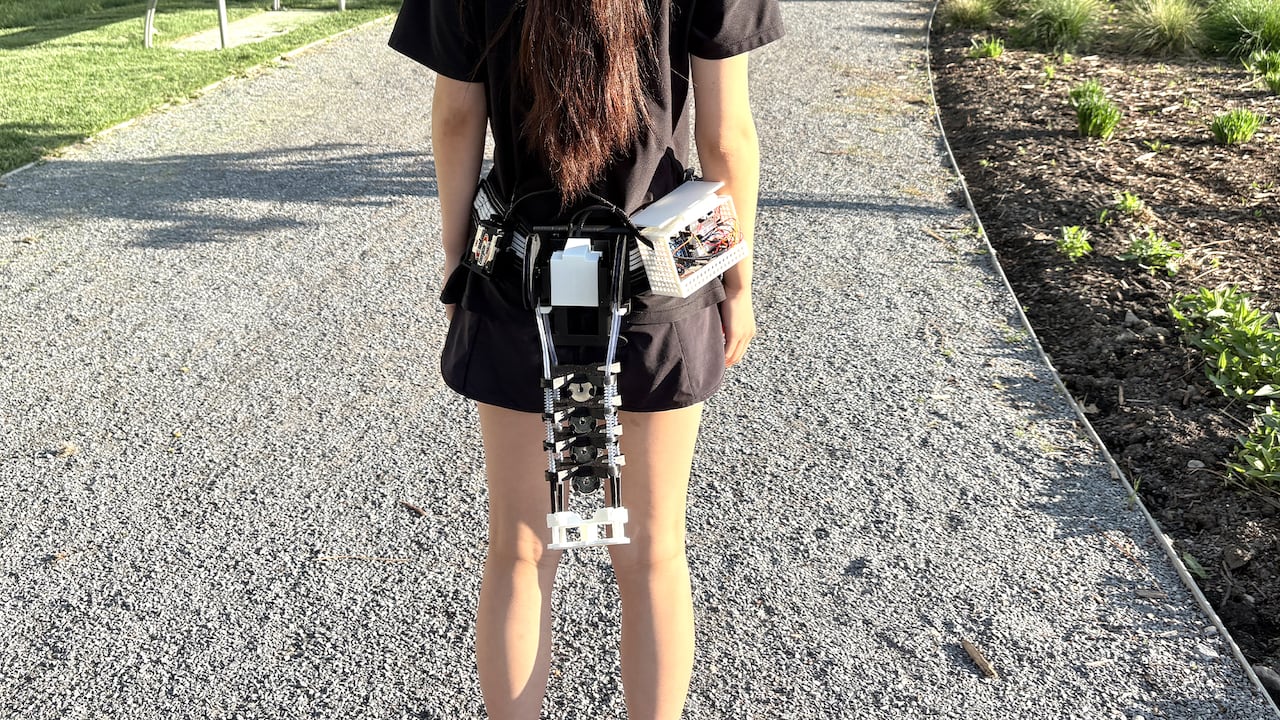
A1: High school students Allen Guo-Lu and Luotong Shi developed a wearable tail technology designed to help individuals with Parkinson's disease maintain their balance. This mechanical belt with a tail can act as a counterweight, adapting to the patient's gait and providing balance support through built-in sensors and an app-controlled sensitivity feature.
Q2: How does wearable technology contribute to the management of Parkinson's disease?
A2: Wearable technology, such as activity trackers and specialized devices, can monitor health metrics and track symptoms, providing real-time feedback to patients and healthcare providers. These tools help in managing Parkinson's disease by improving balance and mobility through biofeedback and personalized settings.
Q3: What are some challenges associated with wearable technology in healthcare?
A3: Challenges include short battery life, limited computing capability, and privacy concerns due to data collection. Wearable devices need advancements in energy efficiency, connectivity, and data security to become more effective and widely adopted in healthcare applications.
Q4: What advancements in wearable technology are helping Parkinson's patients regain motor control?
A4: Recent advancements include the development of wearable vibrating technology and 3D-printed shoe soles that restore the brain-body feedback loop, aiding patients with Parkinson's in improving motor skills, balance, and gait. These innovations use small vibration devices to provide more comfortable and effective support.
Q5: How does the wearable tail technology differ from other wearable devices for Parkinson's patients?
A5: The wearable tail technology is unique as it mimics the function of a tail to provide balance, with the ability to adapt its weight and sensitivity to each patient's needs. This contrasts with other devices that may focus on broader metrics like heart rate or step count without providing physical support for balance.
Q6: What role do students and young innovators play in the development of wearable technology for medical applications?
A6: Students and young innovators are crucial in developing novel solutions for medical applications, as seen with the wearable tail for Parkinson's patients. Their fresh perspectives and innovative ideas can lead to breakthroughs that improve quality of life and expand the possibilities of wearable technology in healthcare.
Q7: What are the potential future developments in wearable technology for Parkinson's disease?
A7: Future developments may include integrated multimodal sensors that capture a wider range of physiological data, and the creation of digital twins to simulate and analyze patient movements. These advancements aim to provide more personalized and effective management of Parkinson's symptoms.
References:
- Wearable technology - Wikipedia
- Management of Parkinson's disease - Wikipedia
- Wearable Communications in 5G: Challenges and Enabling Technologies
- Investigating Voice as a Biomarker for leucine-rich repeat kinase 2-Associated Parkinson's Disease
- Toward future diagnostics of Parkinson's disease: a perspective on multimodal motor assessment and personalized digital twins
- Calgary high school students develop wearable technology for those with Parkinson's disease
- This wearable tech is helping Parkinson's patients regain control through cutting-edge neuroscience