

Summary
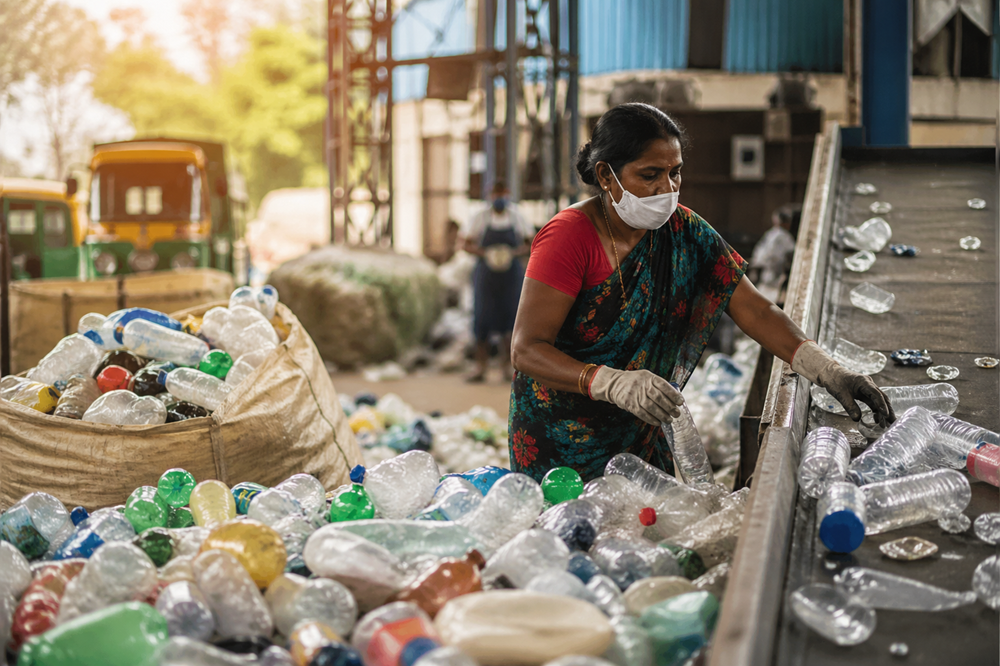
We collect more plastic waste than most nations ever will, yet circularity continues to remain out of reach. The answer lies not in collection, but in what happens before the recycler ever sees the material.
India does not have a plastic collection problem. It has a quality problem. That sounds cou…
Source: ET Edge Insights

AI News Q&A (Free Content)
Q1: What are the primary challenges India faces in achieving a successful circular economy, particularly regarding waste sorting?
A1: India's circular economy is hindered mainly by the quality of waste sorting rather than the quantity of waste collection. The country collects a significant amount of plastic waste; however, the sorting process before recycling is inefficient, leading to challenges in achieving circularity. Efficient sorting is crucial to ensure that recyclable materials are appropriately categorized and processed.
Q2: How is Artificial Intelligence being used to address waste detection and sorting challenges?
A2: Artificial Intelligence is being utilized to enhance waste detection and classification. Research has developed an open-source framework that employs neural networks to detect litter and classify it into categories such as bio, glass, metal, plastic, and more. This approach achieves high precision and accuracy, aiding in improving the efficiency of sorting processes and tackling waste pollution effectively.
Q3: What innovations are being explored to improve the recyclability of electronic waste components?
A3: Innovations in the recyclability of electronic waste include using mathematical models and AI for the automatic disassembly and sorting of waste printed circuit boards. These models evaluate the recyclability of electronic components, helping to reclaim critical raw materials and facilitating the recycling process by determining the complexity of recycling different components.
Q4: What impact does the improper sorting of plastic waste have on recycling efforts in India?
A4: Improper sorting of plastic waste significantly reduces the effectiveness of recycling efforts in India. When recyclable materials are not accurately sorted, they often end up in landfills or are incinerated, leading to environmental pollution and a loss of valuable resources that could have been reused in the production cycle.
Q5: Can you describe a case study where waste collection optimization was achieved through route sequencing?
A5: A case study in Bahía Blanca, Argentina, demonstrated the optimization of waste collection through the sequencing of micro-routes, modeled as a vehicle routing problem. By using mixed-integer programming, the study estimated total distances and travel times for waste collection, suggesting the installation of a transfer station to reduce traveled distances, thereby optimizing the collection process.
Q6: What role does government policy play in supporting the circular economy in India?
A6: Government policy plays a crucial role in supporting India's circular economy by setting regulations and standards for waste management, promoting recycling initiatives, and encouraging public-private partnerships. Policies that incentivize proper waste sorting and recycling can significantly enhance the efficiency of circular economic practices.
Q7: In what ways can the general public contribute to improving waste sorting and recycling in India?
A7: The general public can contribute to improving waste sorting and recycling by actively participating in waste segregation at the source, using designated bins for different types of waste, and supporting recycling programs. Public awareness campaigns and education on the importance of proper waste management can also drive community involvement and enhance the effectiveness of recycling efforts.
References:
- Waste detection in Pomerania: non-profit project for detecting waste in environment
- Measuring the Recyclability of Electronic Components to Assist Automatic Disassembly and Sorting Waste Printed Circuit Boards
- Optimization of waste collection through the sequencing of micro-routes and transfer station convenience analysis: an Argentinian case study