

Summary
Heliconiini maximum reported lifespan data collation
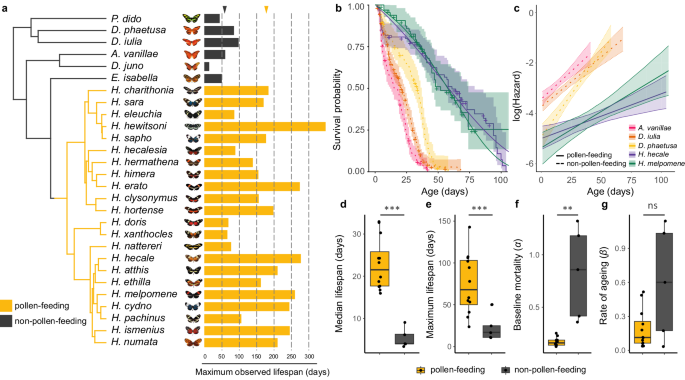
Data on maximum reported lifespan for species across the Heliconiini tribe (Table 1 and Supplementary Data 2) were collated from a literature search within PubMed, Google Scholar, and Web of Science for long-term studies of Heliconius and other H…
Source: Nature

AI News Q&A (Free Content)
Q1: What is the maximum reported lifespan of the Heliconius butterfly, and how does it compare to its relatives in the Heliconiini tribe?
A1: The Heliconius butterfly, specifically Heliconius hewitsoni, has a maximum reported lifespan of 348 days, which is significantly longer than its relatives in the Heliconiini tribe, such as Dione juno, which has a lifespan of only 14 days. This represents a 25-fold difference in maximum lifespan, highlighting the unique longevity of the Heliconius species.
Q2: How has the transition to pollen-feeding contributed to the increased lifespan of Heliconius butterflies?
A2: Pollen-feeding in Heliconius butterflies is associated with a significant extension in lifespan. Pollen-fed Heliconius butterflies have a mean maximum lifespan of 177.36 days, compared to 57.67 days for non-pollen-feeding relatives. This dietary adaptation has been linked to slowed actuarial and physiological aging, contributing to their exceptional longevity.
Q3: What are some of the evolutionary mechanisms that have enabled Heliconius butterflies to achieve longer lifespans?
A3: Heliconius butterflies have evolved unique strategies for extended lifespan, including a transition to pollen-feeding, which supports longevity. They exhibit lower baseline mortality and slower aging rates. These adaptations have allowed them to live significantly longer than their non-pollen-feeding relatives.
Q4: What role do pollen resources like Psiguria flowers play in the diet and lifespan of Heliconius butterflies?
A4: Psiguria flowers provide a reliable pollen source for Heliconius butterflies, supporting their extended lifespan. These plants can flower continuously for up to a year, allowing Heliconius butterflies to establish 'traplines'—foraging routes where they regularly visit specific plants. This behavior is crucial for accessing consistent pollen resources, which contribute to their longevity.
Q5: How does the lifespan of Heliconius butterflies compare to that of other long-lived insects?
A5: The lifespan of Heliconius butterflies, particularly Heliconius hewitsoni with up to 348 days, is among the longest recorded for butterflies. While some insects like certain species of bees can also live for extended periods, the longevity of Heliconius is notable among butterflies due to their dietary adaptation to pollen-feeding.
Q6: What insights into human aging might be gleaned from studying the Heliconius butterfly's longevity?
A6: Studying Heliconius butterflies' longevity can provide insights into mechanisms of aging that are highly conserved across species. Their extended lifespan and slowed aging processes offer a model for understanding how similar mechanisms might be applicable to promoting healthy aging in humans.
Q7: What future research directions are suggested for studying longevity in Heliconius butterflies?
A7: Future research could focus on the genetic and physiological mechanisms underpinning the longevity of Heliconius butterflies, particularly the role of pollen-feeding. Investigating how these butterflies manage oxidative stress and repair damage over their extended lifespans could yield valuable insights into aging processes.