Summary
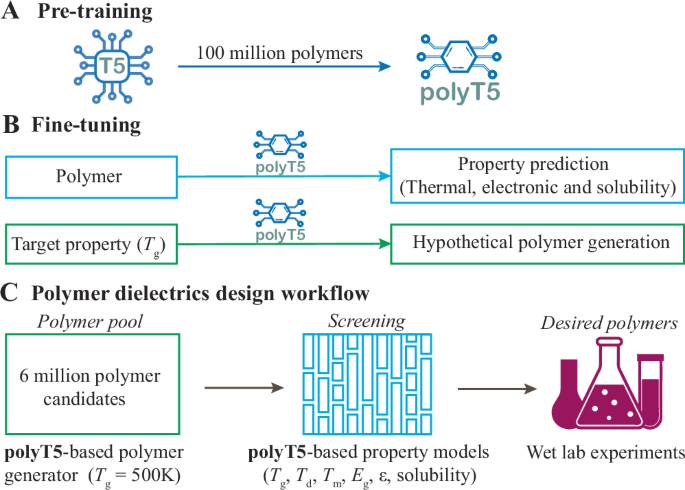
This section details the development and evaluation of POLYT5, demonstrating how the model learns polymer chemistry from large-scale data and applies this knowledge to predictive and generative tasks. We first describe the construction of the polymer corpus and foundation model, followed by fine-tun…
Source: Nature

AI News Q&A (Free Content)
Q1: What is POLYT5 and how does it contribute to generative polymer design?
A1: POLYT5 is an encoder-decoder chemical language model based on the T5 architecture, specifically designed for generative polymer design. It enables both property prediction and the targeted generation of polymers conditioned on desired property values. POLYT5 has been applied to dielectric polymer design, successfully generating candidates with specific dielectric constants, bandgaps, and glass transition temperatures, which were subsequently validated experimentally.
Q2: How does POLYT5 achieve property prediction and generative design tasks?
A2: POLYT5 achieves property prediction by reaching RMSEs of 40.82, 67.07, and 78.59 K for Tg, Tm, and Td, respectively, and 0.60 eV and 0.65 for Eg and ε. For generative design, POLYT5 produced hypothetical polymers targeting specific Tg values, demonstrating diverse and chemically valid candidates rather than trivial replicas, thus capturing structure-property relationships effectively.
Q3: What are the significant outcomes of the POLYT5 model's application in polymer design?
A3: The POLYT5 model successfully generated over 20,000 promising polymer candidates, one of which was synthesized and validated, showing strong agreement with predicted properties. This demonstrates the model's capability to facilitate the accelerated discovery of polymers with desired properties, such as dielectric constants, bandgaps, and glass transition temperatures.
Q4: In what ways can POLYT5 impact the field of polymer chemistry?
A4: POLYT5 allows for rapid exploration of polymer design spaces, enabling the generation of polymers that meet specific property requirements. This could significantly speed up the development of new materials by reducing reliance on exhaustive experimental processes, thus transforming polymer chemistry into a more data-driven field.
Q5: How is POLYT5 integrated into AI frameworks for enhanced usability in polymer design?
A5: POLYT5 is integrated within an agentic AI framework that couples it with a general-purpose language model, allowing scientists to interact with the model using natural language. This integration facilitates property prediction and generative design through a user-friendly interface, lowering the barrier to entry for material scientists in the polymer design process.
Q6: What are the challenges addressed by POLYT5 in generative polymer modeling?
A6: POLYT5 addresses key bottlenecks by incorporating synthetically aware criteria into its framework, such as commercially available monomer reactants, known synthetic pathways, and hypothetical polymerization reaction conditions. This approach ensures the experimental and synthetic viability of the generated polymer designs.
Q7: What is the significance of validating POLYT5-generated polymer candidates experimentally?
A7: Experimental validation of POLYT5-generated candidates is crucial as it confirms the accuracy and reliability of the model's predictions. It demonstrates that the model can produce real-world applicable polymers, which is essential for its adoption in practical polymer design and development.
References:
- An Encoder-Decoder Foundation Chemical Language Model for Generative Polymer Design
- For property prediction, POLYT5 achieved RMSEs
- This work reports the first demonstration of incorporating a robust set of synthetically aware criteria