Summary
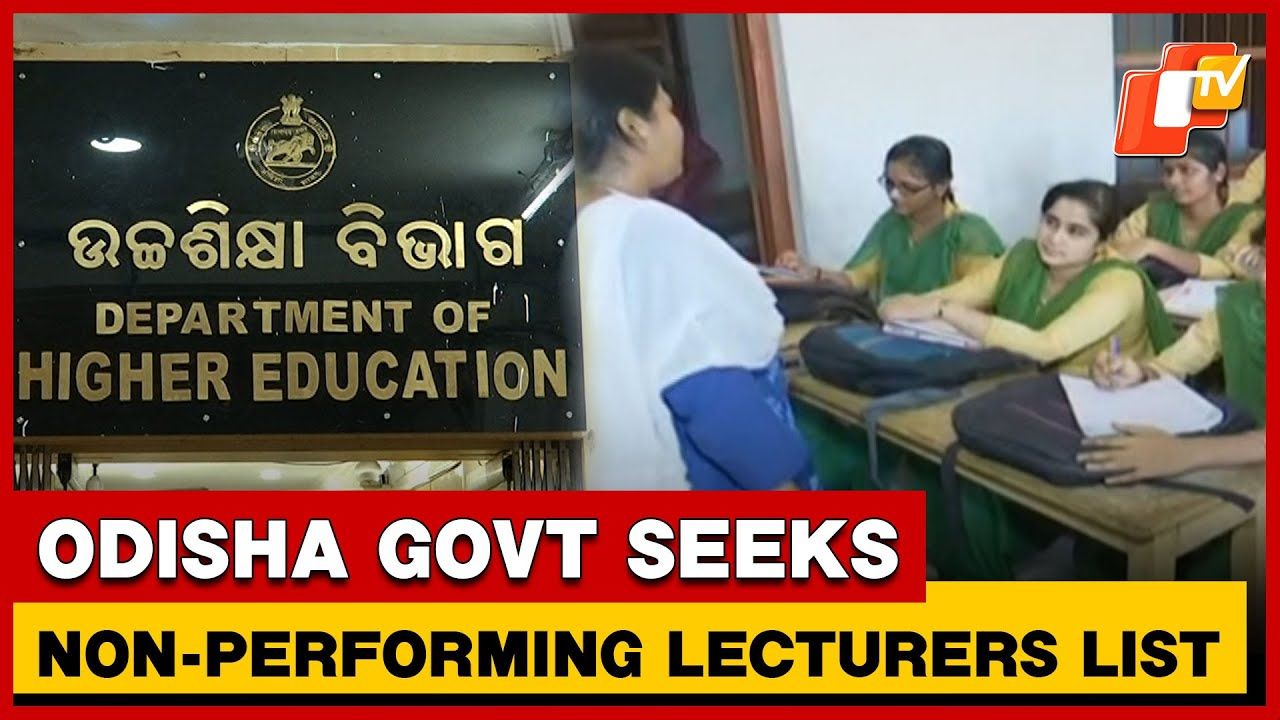
Odisha Govt Seeks List Of Non-Performing Lecturers For Compulsory Retirement | OTV #lecturerupdate #govtaction #highereducation #odishagovt #nonperforminglecturers #compulsoryretirement #educationreform #odishanews #odisha #otv #otvnews #otvenglish #otvnewsenglish———————————————————————————————————OdishaTV is Odishas no 1 News Channel. OTV being the first private satellite TV channel in Odisha carries the onus of charting a course that behoves its pioneering efforts.Accordingly its charter objectives are FREE, FAIR and UNBIASED. OTV delivers reliable information across all platforms: TV, Internet and Mobile.Stay tuned for all the breaking news !Visit Our Website https://odishatv.in/Android App: bit.ly/OTVAndroidAppiOS App: http://bit.ly/OTViOSAppWatch Live: http://live.odishatv.in/YouTube: https://goo.gl/Ehz6OPFacebook: https://www.facebook.com/otvnewsOTV English Facebook : https://www.facebook.com/otvenglishTelegram @otvtelegram @otvkhabarTwitter: https://twitter.com/otvnewsInstagram: https://www.instagram.com/otvnews/#OTVNews #OdishaTV
Source: Odisha Tv

AI News Q&A (Free Content)
Q1: What prompted the Odisha government to seek a list of non-performing lecturers for compulsory retirement?
A1: The Odisha government initiated the process to identify non-performing lecturers for compulsory retirement as part of efforts to enhance academic standards and accountability within higher education institutions. This move involves a structured review process requiring universities and colleges to submit detailed reports on faculty performance by January 31st, assessing teaching standards and work practices.
Q2: How does the process of identifying non-performing lecturers work, according to the Odisha government's directive?
A2: The process involves examining service records, performance appraisal reports, integrity status, and overall conduct of college teachers. It requires authorities to submit proposals backed by supporting documentation and approved at the relevant level, ensuring adherence to natural justice and applicable regulations. This aims to maintain academic standards and administrative efficiency.
Q3: What historical context does Odisha hold in terms of its educational and administrative framework?
A3: Odisha, known as Orissa until 2011, has a rich historical context, including the ancient kingdom of Kalinga. Its governance structure includes an executive led by the Governor, a judiciary, and a legislative branch with Bhubaneswar as the capital. It has a unicameral legislative assembly and a significant representation in the Indian Parliament.
Q4: How does the current initiative by the Odisha government compare to historical education reforms in India?
A4: Similar to historical education reforms, such as the Inquiry-Based Mathematics Education movement, Odisha's current initiative also aims to improve educational outcomes. However, unlike the IBME reform which faced criticism for lack of evidence, Odisha's initiative is based on a structured evaluation process to enhance academic standards.
Q5: What are the potential impacts of the Odisha government's decision on the higher education sector in the state?
A5: The decision could lead to improved teaching standards and accountability in higher education institutions. By enforcing a review of faculty performance, the initiative aims to address inefficiencies and enhance the quality of education, thereby potentially increasing the state's academic reputation and student outcomes.
Q6: What challenges might the Odisha government face in implementing this policy of compulsory retirement for non-performing lecturers?
A6: Challenges may include ensuring fairness in the evaluation process, managing resistance from faculty and unions, and maintaining transparency and adherence to principles of natural justice. Additionally, the government must address potential legal and administrative hurdles in aligning the policy with existing service rules and guidelines.
Q7: What are the broader implications of such education reforms for other states in India?
A7: If successful, Odisha’s reform could serve as a model for other states aiming to improve their higher education systems. It highlights the importance of accountability and performance evaluation in educational institutions, potentially inspiring similar initiatives nationwide to enhance overall academic standards and outcomes.
References:
- Inquiry-Based Mathematics Education: a call for reform in tertiary education seems unjustified