Summary
Ever wonder what happens when those shiny fuel cell stacks in EVs or backup generators finally call it quits? In the world of clean energy transition, building
Source: hydrogenfuelnews.com

AI News Q&A (Free Content)
Q1: What are hydrogen fuel cells and how do they function?
A1: Hydrogen fuel cells are electrochemical cells that convert the chemical energy of hydrogen and an oxidizing agent, often oxygen, into electricity through redox reactions. They require a continuous supply of fuel and oxygen to sustain the reaction. The cell consists of an anode, a cathode, and an electrolyte. At the anode, hydrogen gas is oxidized, producing electrons and protons. The electrons flow through an external circuit to the cathode, producing electricity, while protons move through the electrolyte. At the cathode, oxygen combines with electrons and protons to form water, completing the reaction.
Q2: Why is recycling important in the context of hydrogen fuel cells?
A2: Recycling is crucial for hydrogen fuel cells because they contain precious metals like platinum group metals (PGMs), which are expensive and finite resources. Recycling helps recover these materials, thus reducing the demand for new mining and lowering production costs. Additionally, recycling supports environmental sustainability by reducing waste and conserving resources.
Q3: What advancements have been made in the recycling of hydrogen fuel cells?
A3: Recent advancements in hydrogen fuel cell recycling include improved techniques for recovering PGMs and other valuable materials from used cells. These advancements aim to increase the efficiency and cost-effectiveness of recycling processes. Research has focused on developing more sustainable and less energy-intensive methods for material recovery, thereby enhancing the overall lifecycle sustainability of hydrogen fuel cells.
Q4: How does the recycling of hydrogen fuel cells contribute to the circular economy?
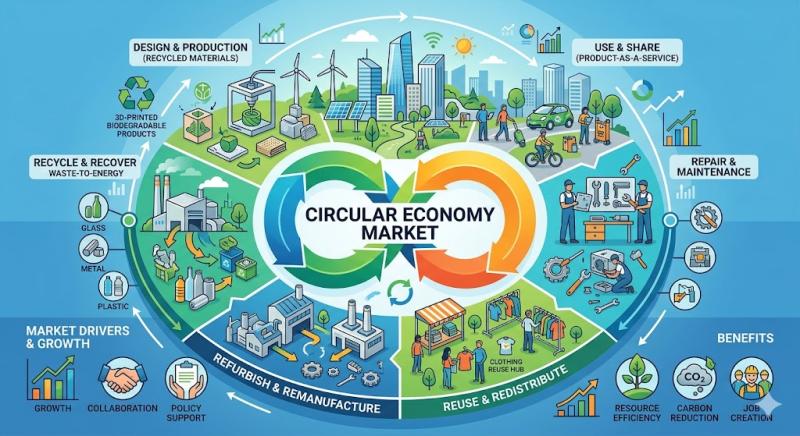
A4: Recycling hydrogen fuel cells contributes to the circular economy by closing the loop on material usage. It allows for the recovery and reuse of valuable materials such as PGMs, reducing the need for new raw materials. This process minimizes waste, reduces environmental impact, and supports sustainable production and consumption, which are key principles of the circular economy.
Q5: What are the environmental benefits of hydrogen fuel cell recycling?
A5: The environmental benefits of recycling hydrogen fuel cells include reduced need for mining new materials, which decreases habitat destruction and pollution associated with mining activities. Recycling also minimizes waste sent to landfills, reduces greenhouse gas emissions by decreasing energy consumption in new material production, and supports the sustainable use of resources.
Q6: What challenges remain in the hydrogen fuel cell recycling market?
A6: Challenges in the hydrogen fuel cell recycling market include the technical complexity of efficiently recovering valuable materials, the need for economic feasibility in recycling processes, and the establishment of robust recycling infrastructure. Additionally, there is a need for standardized processes and regulations to ensure safe and effective recycling practices.
Q7: What role do scholarly articles suggest for improving hydrogen fuel cell recycling technologies?
A7: Scholarly articles suggest that improving recycling technologies for hydrogen fuel cells requires interdisciplinary research combining materials science, chemistry, and engineering. Innovations in catalyst recovery, membrane separation, and process optimization are key areas of focus. Collaboration between industry, academia, and government is also emphasized to drive technological advancements and facilitate the adoption of improved recycling practices.
References:
- Fuel cell
- Predicting fuel research octane number using Fourier-transform infrared absorption spectra of neat hydrocarbons
- arxiv.org/abs/1606.07075