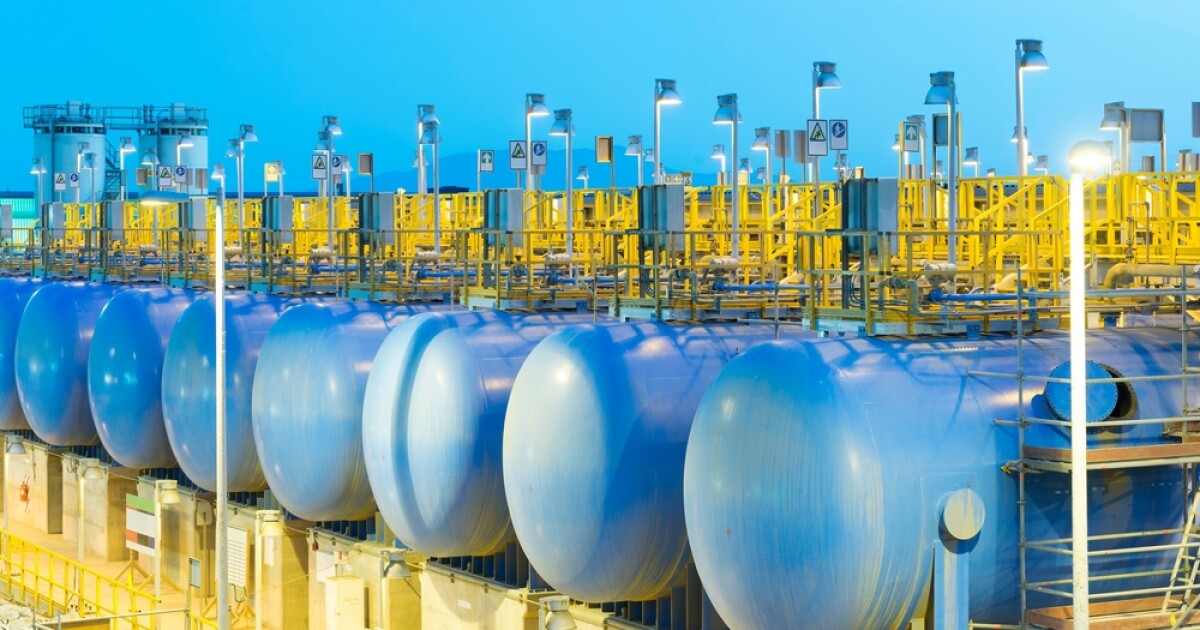
Summary
Desalination is often seen as an inevitable answer to Middle East water scarcity. But as capacity scales, the bigger question is no longer whether the region can produce enough water it is whether it can do so without locking in a major emissions and power-system burden. The shift from thermal pla…
Source: Energy Intelligence

AI News Q&A (Free Content)
Q1: What are the primary desalination technologies used in the Middle East, and how do they impact energy consumption?
A1: The primary desalination technologies in the Middle East are multistage flash distillation (MSF) and reverse osmosis (RO). MSF is a thermal process that requires about 25 kWh of energy and emits approximately 9 kg of CO2 per cubic meter of water produced. Conversely, RO, which uses membrane technology, is more energy-efficient, consuming 3-6 kWh per cubic meter, with a carbon footprint of 2.3 kg of CO2 equivalent. RO now constitutes about 69% of installed desalination capacity due to advancements in membrane technology and integration with renewable energy.
Q2: How is solar energy being integrated into desalination processes to achieve net-zero emissions?
A2: Solar desalination uses solar energy to power the desalination process through thermal or photovoltaic means. Recent innovations include passive and modular solar thermal distillers, capable of producing nearly 3 L/m²/h of clean water under less than one sun of solar intensity. These systems are designed to be low-cost, modular, and can significantly reduce reliance on fossil fuels, aligning with global net-zero emissions goals.
Q3: What role do technological advancements play in making desalination more sustainable and economically viable?
A3: Technological advancements such as improved membrane technology, energy recovery systems, and the integration of renewable energy sources have made desalination more energy-efficient and cost-effective. These innovations reduce environmental footprints and operational costs, making desalination a feasible solution for water-scarce regions. The market is expected to grow at a compound annual growth rate of 11% from 2023 to 2033, driven by these technological improvements.
Q4: How does the Middle East's reliance on desalination affect its energy consumption and carbon footprint?
A4: Desalination in the Middle East accounts for 5% of the region's total energy consumption. The majority of this energy is derived from fossil fuels, which contributes significantly to the region's carbon footprint. However, the shift towards more energy-efficient RO systems and the potential integration of renewable energy sources offer pathways to mitigate these environmental impacts.
Q5: What are the economic implications of desalination for countries heavily relying on this technology?
A5: Countries relying heavily on desalination, such as those in the Middle East, face high operational costs due to energy requirements. However, investments in advanced desalination technologies and renewable energy integration can reduce these costs. The desalination market's expansion is supported by public-private collaborations and government investments aimed at ensuring water security, with projected growth rates of 10% annually from 2025 to 2030.
Q6: How does the integration of renewable energy into desalination processes impact the overall cost and resilience of water supply?
A6: The integration of renewable energy, such as solar and wind, into desalination processes can significantly reduce the Levelized Cost of Water by up to 20% compared to grid-only systems. This approach also enhances the resilience of water supply systems by reducing dependency on volatile fossil fuel prices and supporting a sustainable, low-carbon water supply.
Q7: What are the challenges and potential solutions for achieving net-zero emissions in desalination systems?
A7: Achieving net-zero emissions in desalination systems involves overcoming challenges related to energy consumption, carbon emissions, and the integration of renewable energy. Potential solutions include the adoption of hybrid systems combining solar, wind, and grid power, advancements in membrane technology, and the development of energy-efficient desalination processes. These solutions aim to reduce the carbon footprint while maintaining efficient water production.